Tanya Field’s organization, The BLK Projek, has turned an old school bus into a veggie mobile market and is in the process of turning an abandoned plot of land into a farm. Ms. Fields said that she keeps prices low — $3 for a dozen organic eggs, $1.50 for a pound of onions, $1 for a pound of turnips — and accepts food stamps along with cash and credit cards. In recent weeks, she has given away much of the produce to attract customers, and simply to help feed those who say they cannot spare even a dollar.

Tanya Fields

When Fields moved to the South Bronx she was a young mother finishing college. She imagined her near future would include a good job and moving out of the area, which she held many preconceived notions about. Mainly: it’s crime-ridden, dirty and polluted, she says. Six months later she was laid off from her job and had to go on welfare. She was also pregnant again and in a destructive relationship. When her second child was born with chronic asthma her hopelessness reached a breaking point. Where she ultimately found solace surprised even her. She could turn her hopelessness into action fighting for environmental justice.
Field’s first program with the BLK Projek, Holistic Hood, included workshops on food justice issues (along with healthy snacks). Then she started guerrilla gardening in abandoned lots, and “getting kicked out of places and getting in trouble with the police,” she says. While looking for a more permanent space for her farming dreams, she came across an old school bus and grew acquainted with a farmer in upstate New York. She’s currently in the process of outfitting the bus with refrigeration units to use it as a mobile vegetable market where South Bronx residents can buy produce from upstate farms. And her farming dreams seem to be coming to fruition. She has recently been granted approval from the city to farm in a 4,300-square-foot, long-abandoned lot in the neighborhood. The space used to be a community garden in the ’80s and ’90s, and she’ll begin cover cropping and building raised beds at Libertad Urban Farm, as she’s named it, in November. She plans to sell the produce she grows here at the Mobile Market. Fields hopes the farm and market can become a job creator as well as a way to revitalize the area. Neighbors are already excited for the farming to begin. As she surveyed the lot recently a neighbor came over to see how things were progressing. Right now the space is overrun and trash-strewn but “they remember when it was a beautiful garden,” says Fields. And someday soon, if Fields has anything to say about it, it will be again.
Source: Modern Farmer

“Ashley Yong knew her dad wasn’t going to pay for prom, so she started saving money. But when it finally came time to prepare for the big night, the high school student didn’t spend the money she saved on the perfect dress or even a prom ticket. Instead, she used it to make a much longer lasting impact. The 17-year-old from Darien, Ill., skipped her senior prom to help homeless people in her community. She spent the money she saved for the dance on items like socks, toothbrushes and food and packed them into 20 boxes. Then, she personally delivered them.” So beautiful.

Source: Huff Post

One of Germany’s most famous anti-Nazi heroes, Sophie Scholl, was born on this day in 1921. As a university student in Munich, Scholl, along with her brother, Hans, and several friends, formed a non-violent, anti-Nazi resistance group called the White Rose. The group ran a leaflet and graffiti campaign calling on their fellow Germans to resist Hilter’s regime. Scholl first became involved in resistance organizing after learning of the mass killings of Jews and reading an anti-Nazi sermon by Clemens August Graf von Galen, the Roman Catholic Bishop of Münster. She was deeply moved by the “theology of conscience” and declared, “Somebody, after all, had to make a start. What we wrote and said is also believed by many others. They just don’t dare express themselves as we did.” In 1943, Scholl and the other members of the White Rose were arrested by the Gestapo for distributing leaflets at the University of Munich and taken to Stadelheim Prison. After a short trial on February 22, 1943, Scholl, her brother Hans and their friend Christop Probst, all pictured here, were found guilty of treason and sentenced to death. At her execution only a few hours later, Scholl made this final statement: “How can we expect righteousness to prevail when there is hardly anyone willing to give himself up individually to a righteous cause. Such a fine, sunny day, and I have to go, but what does my death matter, if through us thousands of people are awakened and stirred to action?” Following the deaths of the White Rose’s leaders, their final leaflet was smuggled to England. In mid-1943, Allied Forces dropped millions of copies of the “Manifesto of the Students of Munich” over Germany. Scholl is now honored as one of the great German heroes who actively opposed the Nazi regime.

Sophie

Thanks to A Mighty Girl for this post.

“I say to you, life is the only truth there is. There is no other god than life. So allow yourself to be possessed by life in all its forms, colors, dimensions – the whole rainbow, all the notes of music. If you can manage this simple thing…. It is simple because it is only a question of let-go. Don’t push the river, let the river take you to the ocean. It is already on the way. Relax, don’t be tense and don’t try to be spiritual. Don’t create any division between the matter and the spirit. Existence is one, matter and spirit are simply two sides of the same coin. Relax, rest, and go with the river.” ~Osho

Art by AquaSixio

Art by AquaSixio

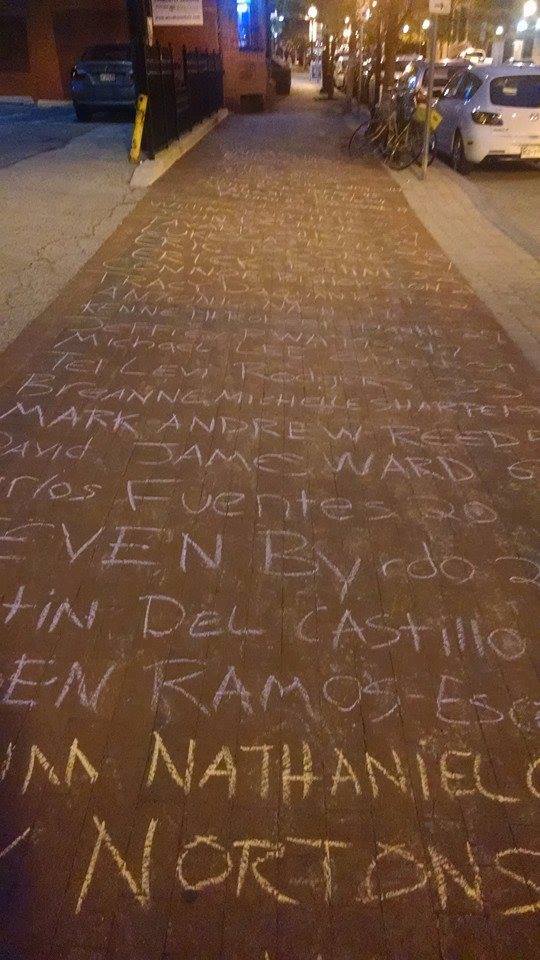
Last week, an activist in Baltimore known only as “April”, began writing names of victims of police brutality along the sidewalk. She began with victims killed on January 1st of 2013 and wrote every name that was recorded until the present day. Names stretched from Penn Station to a George Washington monument in the middle of the city, which is nearly a mile in distance. Wow.

chalk-names

Source: The Anti Media